
ICE Detainee Release Records
The ICE Online Detainee Locator System locates people in ICE custody. ICE states that the tool covers a detainee currently in ICE custody or in Customs and Border Protection custody for more than 48 hours. Public guidance also describes the identity facts needed for a search. This function is narrower than a county release log.
No reviewed source shows that the Crisp County Jail is a dedicated ICE detention contract facility. Immigration custody should therefore be treated as a when-relevant branch. A Crisp County record may say the person was released or transferred to ICE. That ends the county's physical custody, but it does not mean the person was free from custody.
Search ICE Detainee Release Status
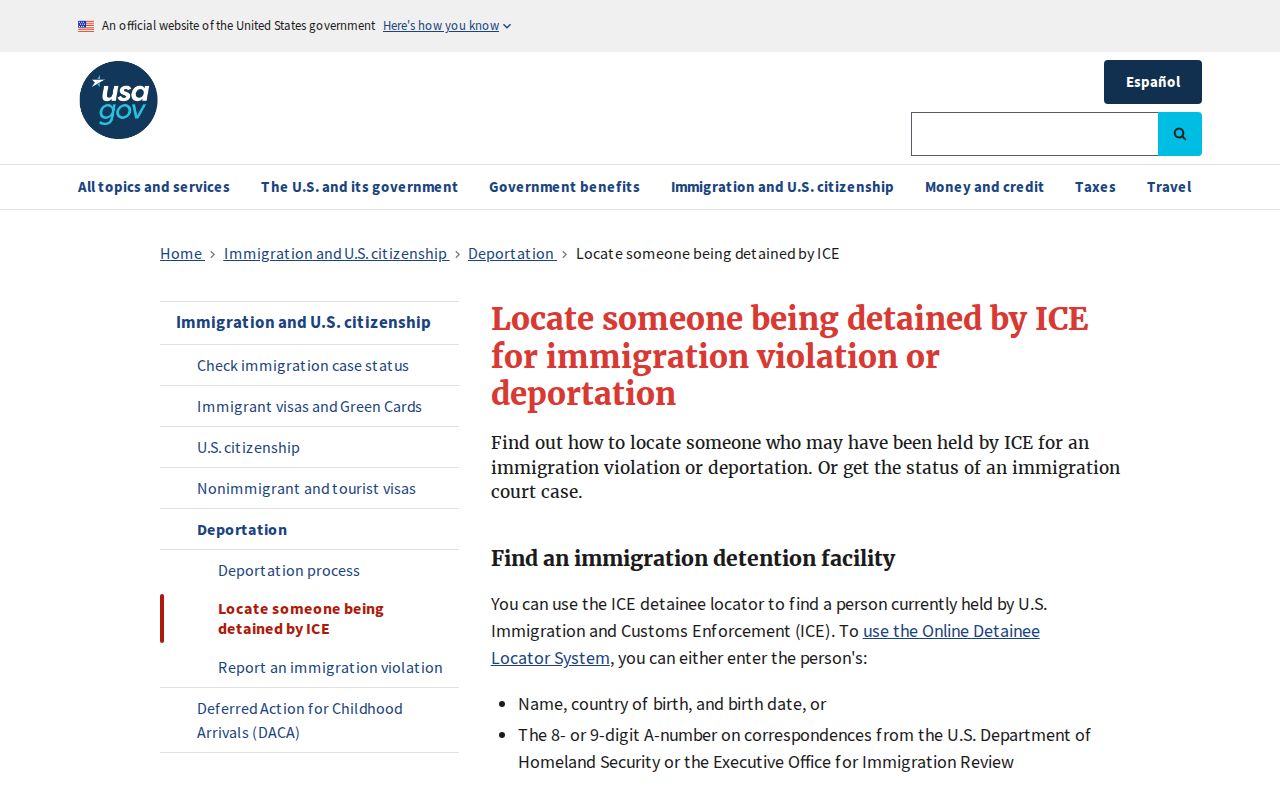
USA.gov's official ICE locator guidance explains two search routes. One uses the person's A-number. The other uses name, country of birth, and date of birth. Exact spelling and complete birth information can be vital when the A-number is not known.
- Open the ICE locator and choose the appropriate search method.
- Enter the A-number when it is known.
- Otherwise, enter the full name, country of birth, and date of birth.
- Compare the result with known identity and custody facts.
- If no result appears, verify the county transfer record and try exact alternate spelling.
- Use the agency contact shown by official guidance when direct confirmation is needed.
The federal guidance page shows the proper source boundary for an immigration custody search.
Read ICE Detainee Release Results
An ICE locator result answers a present immigration custody question within the system's stated limits. It should not be stretched into a complete history of arrest, court action, bond, jail booking, or transfer. The locator may also have limited value after a person leaves the custody window that the system covers.
| Information | Use and limit |
|---|---|
| A-number | A precise immigration identifier used for the search. |
| Name | Must be matched with other identity facts. |
| Country of birth | Required with the name-based search described by USA.gov. |
| Date of birth | Helps narrow a name-based match. |
| Custody or location result | Read only as the ICE system's current public statement. |
The locator is not expected to provide a Crisp County booking number, county release reason, local bond order, Georgia sentence, or GDC discharge date. Request those facts from the office that created them.
Crisp County ICE Release Transfer
The county record is the best starting point when Crisp County was the last known place of confinement. Ask whether the person left the jail for the community or was delivered to another authority. The transfer destination is central. Without it, the word “released” can be misunderstood.
For an immediate local status question, call the Crisp County Jail at (229) 276-2646 or (229) 276-2647. For a documentary response, send an open-records request to openrecords@crispcounty.com. Include the person's full name, date of birth if known, booking date, and booking number. Request the release date and time, release type, receiving agency, and transfer destination.
A county court file may explain the local case result but may not resolve the separate immigration custody event. A local bond or sentence-completion order can end the state basis for detention while an immigration hold produces another custody step. Track both records instead of treating one as a substitute for the other.
Note: The county jail can confirm who received the person, while ICE is the source for the next immigration custody status.
ICE Versus Other Release Systems
The custody type determines the tool. VINELink reports changes in participating county and state custody systems. GDC covers sentenced Georgia offenders. BOP covers federal prisoners from 1982 to the present. USMS manages federal pretrial detention and transport. ICE addresses immigration custody.
| Last authority | Correct next source |
|---|---|
| Crisp County Jail | Sheriff release record, VINE, and court order |
| Georgia prison | GDC offender search and records verification |
| Federal prison | BOP Inmate Locator |
| Federal pretrial custody | USMS and federal court records |
| Immigration custody | ICE detainee locator and official ICE contact |
A person can appear in more than one row over time. The order of events matters. Preserve the date, source, and exact custody wording for each step.
Missing ICE Detainee Release Results
No result is not proof of community release. The person may not meet the locator's public coverage, the identity facts may not match, the transfer may be recent, or another authority may hold the person. Start by confirming the Crisp County destination. Then repeat the search with an accurate A-number or exact biographical details.
If BOP appears instead, the matter may involve federal prison rather than ICE detention. If USMS appears, the person may be awaiting federal proceedings or transport. If GDC appears, the county release was likely a state transfer. A current-custody system can also stop showing someone after release, so a source record remains important when the event itself must be documented.
- A-number
- The immigration registration number used to identify a person in federal immigration systems.
- Detainer
- A request or hold that can lead one authority to transfer a person to another.
- Transfer
- A change in custodian while confinement continues.
- Release
- The end of custody under the authority reporting it.
ICE Detainee Release Timing
The locator's public coverage language makes timing important. ICE describes the tool for a person currently in ICE custody or in CBP custody for more than 48 hours. A recent county handoff may therefore require patience and direct confirmation. The Crisp County jail record remains the best proof of when local custody ended, even if the receiving federal system has not yet produced a public match.
County processing also has its own timing. The sheriff explains that release or booking work can depend on charges, processing volume, and cooperation. That local delay should not be confused with an ICE locator delay. Record the time of the county event, the named receiving agency, and when each ICE search was attempted.
If the person later leaves immigration custody, the public locator may offer only limited historical help. Preserve any result and seek the agency record when the exact release date or location is required. A current locator is designed to locate custody, not to reconstruct every prior handoff in the Crisp County and federal chain.
ICE and Crisp Court Records
A Crisp County court can resolve the local charge without resolving immigration custody. Magistrate Court handles matters such as first appearances, bond routing, and warrants. The Superior and Juvenile Courts Clerk maintains criminal filings and sentence or disposition records. A dismissal, bond order, or sentence completion can explain why the county no longer holds the person.
An immigration detainer can create a second event after that local result. Ask the jail whether the person went to ICE and request the transfer destination. Then search the ICE locator with an A-number or the required name and birth details. The local court record and the ICE record should be kept side by side because neither office creates the other's decision.
If the jail instead names USMS, the case may involve federal criminal custody rather than immigration detention. If it names GDC, use the state offender search. If it names another county, contact that receiving jail. This destination-first method is more accurate than assuming every hold or federal transfer belongs to ICE.
Confirm ICE Detainee Release Records
Build the confirmation from both ends. Obtain the Crisp County release or transfer record. Search ICE with the right identifiers. Check whether the receiving authority and date align. When a court order caused the local release, obtain that order too. Each record should answer only the part created by its agency.
Do not infer an immigration outcome from a county record, and do not infer a local case outcome from the ICE locator. For a wider route across county, state, parole, federal, and immigration records, use the Crisp County released inmate search. It keeps a transfer from being mistaken for discharge or return to the community.
When no match appears, document the search inputs and time. Recheck the spelling, date of birth, country of birth, and A-number. Then compare those facts with the Crisp County booking record. A wrong digit or name form can produce an empty search even when the transfer destination is correct.
If the person was released from ICE custody, request confirmation from the federal source that created that event. The county jail can document only its own handoff. The court can document only the local case result. Keeping those limits clear prevents a county bond order from being treated as an immigration release decision.