
Crisp Magistrate Release Records
Magistrate Court is important at the beginning of many local cases. Its records can cover warrants, first appearances, bond-setting, preliminary matters, and misdemeanor or other matters within its role. Those events can explain why a person left Crisp County Jail soon after arrest.
The Sheriff's Office states that bail can be determined by a judicial official after intake steps that include identification, warrant checks, photograph, fingerprints, and computer entry. Most inmates may be eligible for bail. The court provides authority, while the jail completes safety and administrative processing and records the actual custody departure.
| Magistrate event | How it relates to release |
|---|---|
| Warrant record | Explains the initial legal basis for arrest |
| First appearance | Early review and rights-related court event |
| Bond decision | May authorize pretrial release |
| Preliminary matter | Can affect the path to a higher court |
| Warrant recall | May change the custody basis |
Confirm Crisp County Bond Release
A bond order is not the same as a completed release. Payment, verification, other holds, the number of people being processed, and jail safety checks can affect timing. The jail says release estimates depend on charges, processing volume, and cooperation.
- Identify the full name, birth date, arrest date, and charge.
- Search for the Magistrate Court case or warrant and read the bond entry.
- Ask the court for the order if an online label is unclear.
- Call the jail to confirm whether processing ended in release or transfer.
- Check VINE for a custody-change notice and use the jail record as the source.
Crisp Magistrate Court Contact
The official Crisp County page gives the office location, weekday hours, phone, and fax.
Crisp County Magistrate Court510 7th Street North, Suite 105
Cordele, GA 31015
Phone: (229) 271-4728
Fax: (229) 271-4715
Office hours: 8:30 a.m. to 5:00 p.m.
Georgia Magistrate Public Records lists Crisp among participating counties. Electronic access can help locate a case, yet it is not a guarantee that every filing or restricted matter appears. Call the office for the correct request path when a record cannot be found.
Ask for the exact item needed, such as a warrant, bond order, first-appearance record, or docket entry. A narrow request reduces same-name errors.
Crisp Jail Processing After Bond
The sheriff's general information says booking can take two to eight hours. It includes medical and mental-health screening, identification, warrant checks, search, photograph, fingerprints, and clerical work. Release work can also take time. Charges, the number of people in processing, and cooperation affect the estimate.
An intoxicated inmate may remain held for up to 24 hours, sometimes longer, until sober enough for safe release. Thus a bond decision can exist while the person still appears in custody. Confirm the completed jail event before arranging pickup or treating the court time as the exit time.
Note: The Crisp County Jail release timestamp, not the bond hearing time, records the end of local custody.
Crisp Bond Versus Disposition
Bond permits release while a case continues. A disposition records the later outcome. Dismissal, plea, conviction, acquittal, time served, probation, or another result may occur well after the person left jail. The proper clerk depends on where the case proceeds.
A felony case can move to Superior Court, where the Clerk of Superior and Juvenile Courts maintains criminal filings and sentencing records. The Magistrate Court record remains useful for the early warrant, first appearance, and bond trail. Compare both when the release occurred early but the final case history is needed.
- Bond
- Security or conditions allowing pretrial release.
- First appearance
- An early court event after arrest.
- Disposition
- The final or recorded case outcome.
- Remand
- An order returning a person to custody.
Crisp Warrant and Hold Checks
A bond in one case may not end custody if another warrant, detainer, or agency hold exists. The Sheriff's Office confirms warrant checks are part of intake. Ask whether the person was released to the community or transferred to another authority.
If the jail reports GDC transfer, use the state offender search. If it reports federal or immigration transfer, use the proper receiving agency. Magistrate Court does not maintain a public county-style release list for those later systems.
The Crisp County release record search explains how to follow the custody chain without treating a transfer as freedom.
Crisp Magistrate Record Limits
The court's office hours and database access do not make it a live jail status service. A docket can lag processing. Sealed, restricted, or confidential records may not appear. Similar names can also cause a wrong match.
Use case numbers and dates whenever possible. For a certified record, ask the court. For the actual time and reason local custody ended, ask the Sheriff's Office for the booking and release record. Georgia's open-records framework calls for a timely response and legal authority for covered records that are withheld.
Keep the roles distinct: the court records legal action, and the jail records physical custody. Together they explain a Crisp County bond release more accurately than either source alone.
Crisp County Jail Release Paths
Crisp County Jail is the local custody facility operated by the Crisp County Sheriff's Office. A release entry may mean freedom to return to the community, but it can also mean a transfer. Bond, time served, dismissal, a citation, or a court order can send a person home. A sentencing order may place the person on probation. Other entries can show delivery to the Georgia Department of Corrections, another county, the U.S. Marshals Service, immigration authorities, a hospital, or another custodial agency.
The distinction controls the next search. When the person returned to the community, the jail's booking and release record, VINE status, and the court file are the best local sources. When Crisp County released the person to GDC, the county record confirms only the end of county custody. The GDC offender search then tracks state custody and any later prison discharge. A federal or immigration transfer also requires the receiving agency's locator, not a second call to the county jail alone.
| Release entry | Where to confirm next |
|---|---|
| Bond or court release | Jail record plus bond order or court docket |
| Time served or local sentence end | Jail release record and sentencing disposition |
| Transfer to GDC | GDC offender search after county transfer |
| Parole or felony probation | Parole Board, DCS, and court order |
| Federal or ICE transfer | USMS, BOP, or ICE tool as applicable |
Confirm Crisp County Jail Release
No official public Crisp County rolling jail roster or recent-release feed was found. A missing name therefore does not prove release. Use the jail as the originating source, then compare VINE and the court record. The full county search and release-record path is also available from the Crisp County released inmates search.
- Call the jail with the full name and date of birth. Ask whether the person remains in local custody, was released to the community, or was transferred.
- Check Georgia VINE by name or booking ID for a custody status change. VINE is an alert system, not the original jail record.
- Ask the proper Crisp County court for the bond, disposition, sentence, or warrant record that caused release.
- If the jail reports a transfer, search the receiving state, federal, immigration, or county system.
- For documentary proof, email an open-records request and ask for the booking and release record.
Crisp County Jail Record Request
The Sheriff's Office says intake includes identification, warrant checks, a booking photograph, fingerprints, and entry in its jail computer information management system. Those steps create the local record trail. Send a focused request to openrecords@crispcounty.com. Include the person's full name, date of birth if known, booking or arrest date, booking number, charge, and court case number. Ask for the release date and time, release reason, bond or order details, and transfer destination if the person did not return to the community.
Georgia's Open Records Act uses a three-business-day response framework. If records exist but cannot be produced in that period, the agency should describe them and give a production timetable. A withholding response must cite legal authority. When estimated costs exceed $25, the agency must give notice and an estimate. The reviewed sheriff pages do not publish a fixed jail-record fee schedule, so do not assume that a copy is free or that a set amount applies.
- Booking record
- The intake record tied to the arrest and jail admission.
- Release reason
- The basis for leaving, such as bond, time served, order, or transfer.
- Transfer destination
- The agency or facility receiving the person after local custody.
- Disposition
- The court's recorded outcome, which may occur after a bond release.
Crisp County Jail Contact
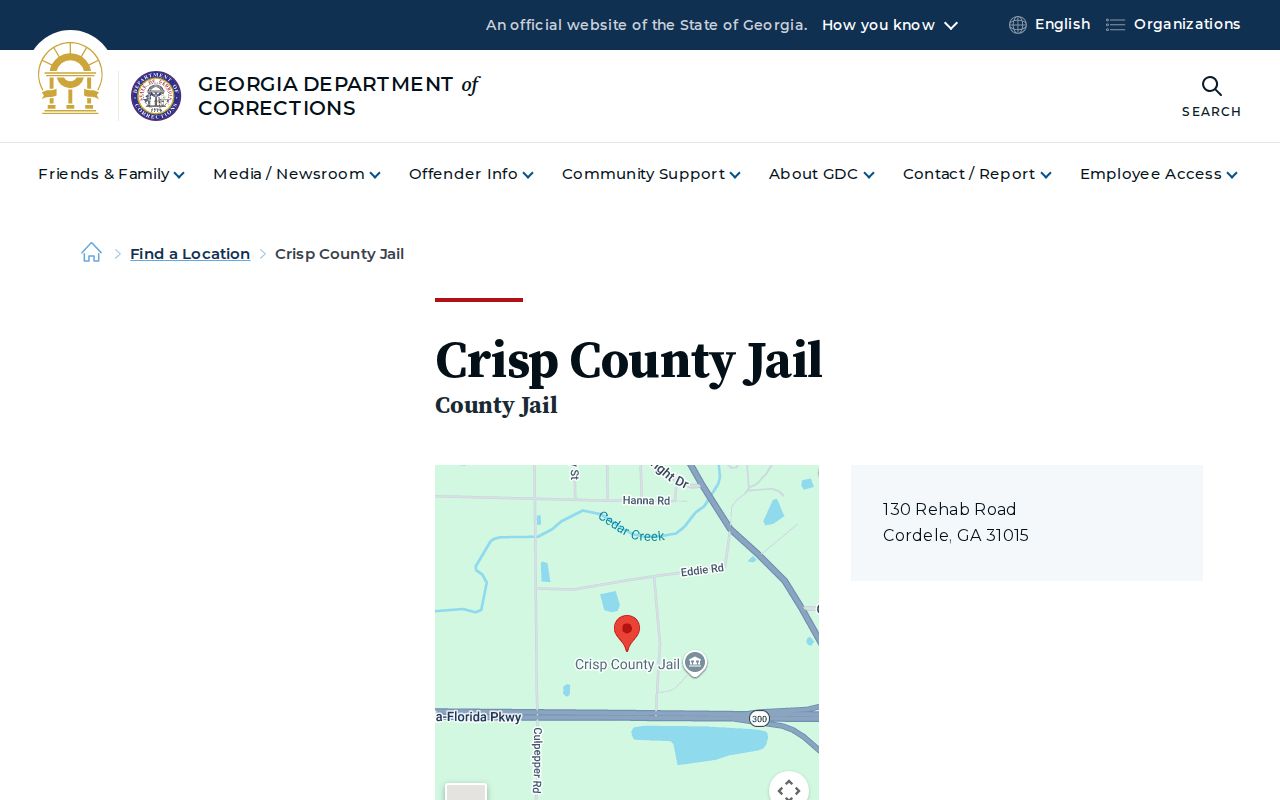
The official GDC county-jail listing and the sheriff site show two useful locations. The detention facility listing uses Rehab Road, while the sheriff administrative address is on Georgia Highway 300 South. Use the jail numbers for custody questions and the open-records email for a record request.
Crisp County Jail / Detention Center130 Rehab Road
Cordele, GA 31015
Jail: (229) 276-2646 or (229) 276-2647Crisp County Sheriff's Office
196 GA Hwy 300 South
Cordele, GA 31015
Office: (229) 276-2600
Fax: (229) 276-2648
The official GDC location page verifies the facility type, address, and primary phone. This listing identifies a county jail, not a state prison. Questions about a later GDC sentence should go to state corrections.
The official listing is also the matching source image for the facility.
Crisp Jail Booking and Release
The sheriff's general information page describes booking as more than clerical entry. It can take two to eight hours and includes medical screening, verbal mental-health screening, identification, warrant checks, search, photographing, fingerprinting, and entry in the jail system. A judicial official may then determine bail and set a court date. Most inmates are described as eligible for bail and able to use telephones to contact family, friends, or bail agents.
Some inmates may qualify for release soon after arrival. That does not promise a fixed time. Charges, the number of people being processed, safety review, and the person's cooperation can change timing. The sheriff also says an intoxicated inmate may remain held for up to 24 hours, or longer, until sober enough for safe release. A signed order or paid bond can therefore precede the actual exit from the jail.
Note: Confirm the completed release event, not merely the court action or payment that started the jail's release process.
Crisp Release Court Trail
A bond release leaves an open case. Magistrate Court may hold first-appearance, warrant, preliminary, or bond records. Superior Court records can show felony disposition, sentence, probation, first-offender treatment, modification, or a later restriction order. These court records can remain useful after the person disappears from a current-custody view.
Read the dates in sequence. The arrest and booking date show admission. A bond or sentencing order supplies legal authority. The jail release timestamp shows when local custody ended. A later GDC admission means the person was transferred rather than freed. A DCS reporting obligation shows community supervision, while a Parole Board entry identifies parole from a state sentence. One record rarely tells the whole story.
Juvenile, sealed, and restricted matters may not be open. Online court access is a search aid and does not guarantee every filing appears. For a complete or certified record, ask the clerk that maintains the case.
After Crisp County Jail Transfer
A state sentence changes both the custodian and the search route. GDC explains that a person may wait in a local jail after sentencing before transfer to a diagnostic facility. Once GDC accepts custody, search by name, description, GDC ID, or case number. A state result may show status, offense and sentence data, a photo when available, and an actual release or discharge date. GDC asks users to verify details in writing with Inmate Records and Information in Forsyth.
Parole is another distinct stage. The State Board of Pardons and Paroles makes parole decisions. DCS supervises parolees and felony probationers in the community. For Crisp County, the Fitzgerald Field Office serves the local area. If the person moved under federal process, USMS can be the transport or pretrial authority, BOP covers federal prison records, and ICE covers immigration detention. None is a Crisp County Jail recent-release list.
Keep the agency chain clear: Crisp County Jail records departure from local custody; the receiving authority records what happened next. That approach avoids mistaking a transfer for a full discharge.