
Understanding Crisp County Releases
A Crisp County release is the end of one agency's custody, not always the end of all legal control. The Crisp County Jail, also called the Crisp County Detention Center in local public information, records local booking and release events. A person may walk out after bond, time served, dismissal, or a court order. Another person may leave the same jail in a transport vehicle bound for the Georgia Department of Corrections, another county, the U.S. Marshals Service, or immigration custody. Both events can be marked as releases from the county jail, but only the first may mean return to the community.
That distinction drives every Crisp County released inmate search. Sheriff Billy Hancock's office is the source for the local booking and release record. The court file explains the bond, sentence, dismissal, probation order, or transfer authority behind it. GDC becomes the source after a state commitment. The State Board of Pardons and Paroles and the Department of Community Supervision show parole decisions and community supervision. VINE reports custody changes, while federal locators apply only when federal or immigration authority is involved.
- Discharge
- The end of custody or a sentence obligation in the system reporting it.
- Time served
- Release after the court credits enough confinement to satisfy the local term.
- Detainer
- A request or hold that may send a person to another authority instead of home.
- Parole
- Release from a state prison sentence to supervision by decision of the Parole Board.
Crisp County Release Types
The release type is often the most useful field in a Crisp County jail record. It tells the reader which office should hold the next record and whether the person likely returned to the community. Bond does not close the criminal case. Probation follows a court order. Parole follows a state prison term and a Parole Board decision. A transfer closes the Crisp County custody episode while another custody episode begins.
| Release type | What it means | Next source |
|---|---|---|
| Bond | The person leaves jail before final case disposition under bond terms. | Magistrate or trial-court bond record |
| Time served | Credited custody satisfies the local confinement obligation. | Sentence and jail release record |
| Dismissal or acquittal | The case ends without a conviction on the affected charge. | Court disposition and restriction process |
| Probation | A court places the person under community terms. | Court order and, for felony cases, DCS |
| Parole | A state prisoner leaves GDC custody under supervision. | GDC, Parole Board, and DCS |
| Transfer | County custody ends because another authority receives the person. | GDC, another jail, USMS, or ICE |
A death, medical transfer, or other exceptional disposition may also close a custody record. Never read the word “released” without the reason and receiving destination. Crisp County Jail can confirm the event it recorded, but the receiving agency controls the status after a transfer.
Crisp County Release Timing
Crisp County's clearest local release detail comes from the sheriff's jail general information. Intake can involve identification, warrant checks, health screening, a photograph, fingerprints, and entry into the jail computer system. Some people may qualify for release soon after arrival. The sheriff also says intoxicated inmates may be held up to 24 hours, and sometimes longer, until they can be released safely.
A judge's order or a paid bond does not always produce an instant exit. Charges, the number of people being processed, and the person's cooperation can affect the time needed to finish release steps. This is why a family member may hear that release is approved while VINE or the jail still reports custody. The sound approach is to wait for the jail's completed release event, then confirm where the person went.
Release approval and physical release are separate events. Confirm the completed Crisp County Jail release before arranging pickup.
Crisp County Bond Releases
Bond-out is part of the local booking sequence. After identification, warrant checks, fingerprints, a photograph, and clerical entry, a judicial official may determine bail and set a court date. The sheriff says most inmates are eligible for bail and receive telephone access to seek help from family, friends, or a bail agent. That access does not mean every person can post bond, since charges and judicial orders control eligibility.
A bond release should connect to more than one record. The jail release record supplies the date, time, and release reason. Magistrate Court may hold the first-appearance, warrant, or bond action. The trial court file carries later hearings and the final disposition. A bond release therefore confirms that custody ended, not that the charge ended. Keep the booking number and court case number together because they make later requests far less prone to a name mismatch.
Does a bond release mean the case is over? No. It means Crisp County custody ended under bond authority. The docket and court order remain the sources for the open case and its terms.
Crisp County Release Record Fields
The sheriff confirms that intake creates a computer booking record with identifying work, a photograph, fingerprints, warrant checks, and court-related processing. No public Crisp County release feed was found, so the fields below are items to request from the jail rather than claims about an online screen. Ask for the full booking and release record. A narrow request helps the records custodian find the correct event and state what can be released under Georgia law.
| Field | What it shows |
|---|---|
| Full name and date of birth | Identifies the correct person when names match. |
| Booking number | Connects the arrest, jail stay, and release event. |
| Booking date and time | Marks when county intake began. |
| Charge and arresting agency | Explains the authority for the booking. |
| Release date and time | Marks when Crisp County custody ended. |
| Release type or reason | Shows bond, time served, transfer, court order, or another basis. |
| Bond or order reference | Points to the court record behind release. |
| Transfer destination | Shows whether another authority received the person. |
| Booking photograph | Identifies the image created during intake, if releasable. |
State records use different labels. A GDC record may show current status, offense, county of conviction, actual release or discharge, and maximum, tentative, or projected dates. Preserve the exact label. A Tentative Parole Month is not the same as an actual release date.
Request Crisp County Release Records
Crisp County Sheriff's Office publishes openrecords@crispcounty.com for open-records requests. The administrative office is at 196 GA Hwy 300 South, Cordele, Georgia 31015. The office number is (229) 276-2600, while the jail lines are (229) 276-2646 and (229) 276-2647. No local jail-release fee schedule was found. Ask for an estimate before authorizing work if a request may require extensive search, redaction, or copying.
- Identify the person by full name, date of birth if known, and the approximate booking date.
- Add the booking number, charge, arresting agency, or court case number when available.
- Request the booking and release record, including date, time, reason, bond reference, and transfer destination.
- Ask separately for the booking photograph if it is needed and releasable under Georgia law.
- Request the specific legal authority for any withheld part and retain the agency's response.
The Georgia Open Records Act generally requires available public records to be produced within a reasonable time not exceeding three business days. When records cannot be ready in that period, the agency must describe them and provide a timeline. Notice and an estimate are required when anticipated costs exceed $25. The law does not promise that every field is public. Juvenile, medical, sealed, restricted, and exempt material may be withheld.
Note: A jail record confirms the custody event, while a certified court order is the better source for the legal outcome.
Crisp County Release Court Records
Crisp County has two local court paths that often explain a quick release. Magistrate Court, at 510 7th Street North, Suite 105 in Cordele, handles matters that may include warrants, first appearances, and bond routing. Its phone is (229) 271-4728, and its listed office hours are 8:30 a.m. to 5:00 p.m. The Clerk of Superior and Juvenile Courts is in the same street address and keeps criminal filings and higher-court case records. That office can be reached at (229) 271-4726.
Choose the office by the record sought. Ask Magistrate Court about a warrant, first appearance, or magistrate bond action. Ask the clerk for the superior-court disposition, sentence, probation order, first-offender discharge, or restriction order. Georgia's e-access services and re:SearchGA may help locate a participating case, but online access can omit older, juvenile, sealed, restricted, or locally held files. A clerk response remains the fallback.
Correct Crisp County Release Records
The sheriff's jail information confirms that Crisp County creates booking data, but no public form for correcting a jail release record was found. Start with the office that owns the disputed fact. The jail or sheriff records unit handles the booking number, custody dates, release entry, and jail photograph. The court clerk handles a sentence, dismissal, bond order, or final disposition. GDC Inmate Records handles a state offender status or state release field.
Record restriction follows a different route. Georgia.gov explains that an arrest before July 1, 2013 is generally routed through the arresting agency. For an arrest on or after that date, the prosecuting attorney is the contact. Restriction is not a universal delete command. A qualifying court or criminal-history result may limit access in some systems while other lawful records remain. Keep copies of the court disposition and each agency response so the exact correction can be matched to its source.
Crisp County Jail Activity Context
The sheriff's monthly reports offer local operational context, but they do not publish release totals. August 2024 reported $58,466 in inmate housing funds returned to the County Commission and 163 prisoners transported for court. July 2024 reported $66,239 and 113 prisoners transported for court. Those figures show that housing and court transport are active parts of local jail work. They must not be relabeled as bookings, releases, or annual totals.
This distinction matters because a transport can look like release from one view. A person taken to court may return to jail. A person transferred to GDC leaves the local facility but stays confined. Monthly operations data can explain workload and delay, yet only an individual booking-release record identifies what happened to one person.
Find Crisp County Released Inmates
Start by naming the custody system. A recent local detainee belongs with Crisp County Jail. A sentenced state prisoner belongs with GDC. A parolee belongs with the Parole Board and DCS. A federal prisoner belongs with BOP, while an immigration transfer belongs with ICE. Searching every portal without this first choice can create false matches and missed releases.
- Call the Crisp County Jail for an immediate local status check, since no official rolling recent-release feed was found.
- Check Georgia VINE by name or booking ID for a custody change or transfer notice.
- Request the jail booking-release record when documentary proof is needed.
- Check Magistrate Court or the Superior Court clerk for the order that explains release.
- Use GDC only if the person entered Georgia state custody, then check parole records if release was to parole.
- Use BOP, ICE, or USMS sources only when federal authority is part of the case.
A missing name does not prove release. It may reflect transfer, delay, spelling, restricted access, or the lack of a public roster.
The Released Last 24 Hours page focuses on same-day confirmation when no county feed exists. For one named person, keep moving through the chain until the custody event and legal reason agree.
GDC Crisp County Release Search
The Georgia Department of Corrections offender query covers state offenders, not people who bonded out of Crisp County Jail before a state commitment. Search by name, description, GDC ID, or case number. A person sentenced in Crisp County may remain in the local jail while awaiting diagnostic transfer, then appear in GDC after state processing.
| Search field | Best use | Caution |
|---|---|---|
| Name | Start a broad search | Compare identifiers for common names |
| Description | Narrow by personal traits | Traits alone do not prove identity |
| GDC ID | Locate a known state record | Not a county booking number |
| Case number | Connect the state record to a sentence | Preserve the exact format |
| Status and date fields | Read custody, release, or discharge | Do not merge maximum, projected, and actual dates |
The GDC query warns that photographs display automatically when available and that the information should be verified in writing with Inmate Records and Information, P.O. Box 1529, Forsyth, Georgia 31029. The portal is a strong official lead. It is not a certified release document.
The official GDC search page below shows where the state path begins. It is relevant only after a Crisp County case enters state corrections.
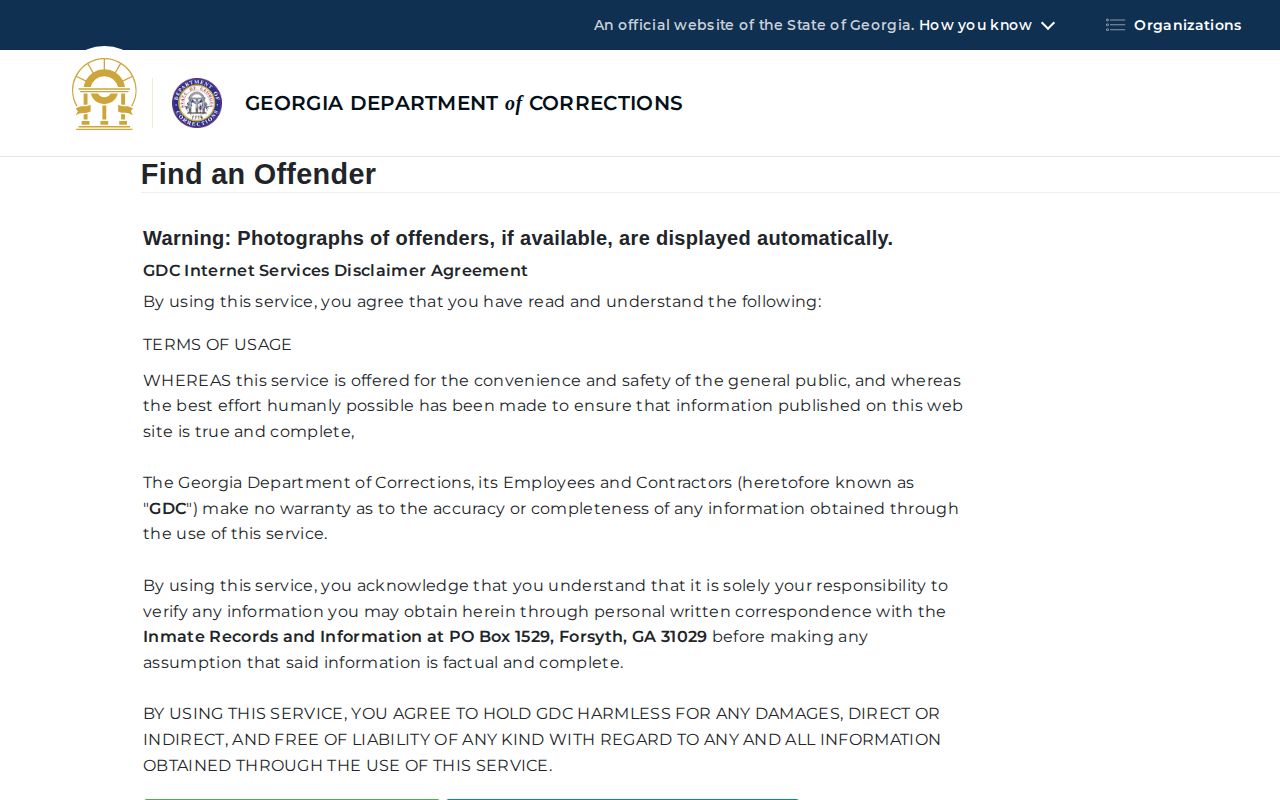
The search disclaimer and field choices reinforce why a state result must be read with its exact labels and checked against the sentence record.
Crisp County Release Supervision
Georgia divides decision and supervision work. The State Board of Pardons and Paroles decides parole and maintains the Inmate TPM Lookup and Parolee Database. The Georgia Department of Community Supervision supervises felony probationers and parolees in the community. A person who leaves Crisp County Jail on bond is not a parolee merely because that person is no longer confined.
The Fitzgerald Field Office serves Crisp, Ben Hill, Dooly, Wilcox, and the Cordele Circuit. It is at 615 S Grant Street, Fitzgerald, Georgia 31750, and its phone is (229) 322-8463. Listed hours are Monday through Friday, 8:00 a.m. to 4:30 p.m. Use the court sentencing order to confirm probation. Use the Parolee Database for a post-release parole record, then the field office for local reporting questions.
A Tentative Parole Month belongs to a person still in prison and is not a final date. The Board may set, postpone, cancel, or change it based on final review, conduct, and required programs. Crisp County parole and probation records must keep the Board's decision separate from the local supervision office path.
Crisp County Release Notifications
Crisp County Sheriff's Office states that it uses VINE. The service can check custody status and send release or transfer notices by phone, text, email, or the VINELink mobile app. Phone search starts with the person's name or booking ID at 1-800-398-2892. TTY service is 1-866-847-1298, and live operator help is available at 1-866-277-7477. Phone registration uses a four-digit PIN to confirm enrollment and later calls.
VINE reports a status change, but the jail or court explains why it happened. It also does not replace federal sources. BOP covers federal prisoners from 1982 to the present and may show a release date or not-in-custody status. ICE search uses an A-number or a name with country and birth information for relevant immigration custody. USMS handles federal pretrial custody and transport but has no county-style release list. If Crisp County releases someone to one of these agencies, the county record shows transfer out, not freedom from custody.
Crisp County Custody Comparison
Released and in-custody records answer different questions. Match the source to the authority and the point in time. A current locator is useful before release. A release record, disposition, or discharge record is useful afterward.
| Situation | Primary source | What confirms the result |
|---|---|---|
| Now in Crisp County Jail | Jail status line and VINE | Current local custody |
| Released from Crisp County Jail | Sheriff booking-release record | Date, reason, and destination |
| State prisoner or state discharge | GDC offender search | Status, exact date labels, and written verification |
| Released to parole or felony probation | Parole Board, court, and DCS | Decision, order, and supervision office |
| Federal prison release | BOP locator | Federal release date or custody status |
| Immigration transfer | County transfer record and ICE locator | End of county custody and next authority |
Note: A transfer date closes one custody episode but does not establish that the person returned to the community.
Restrict Crisp County Release Records
Georgia often uses the term record restriction rather than expungement. A dismissal, acquittal, first-offender discharge, or another qualifying outcome can affect access, but the result is not automatic in every system. The arrest date determines the starting office for many requests. Pre-July 2013 arrests generally begin with the arresting agency, while later arrests generally begin with the prosecuting attorney.
First-offender rules can also limit public access after successful completion. Court orders may restrict or seal specified court, arrest, jail, or detention records. The safest course is to obtain the final disposition, follow the Georgia process for that arrest date and outcome, and then send the proper order to each record holder. A restricted court file does not justify guessing about what another system still displays.
Crisp County Release Systems
The Facility Map includes the local jail plus every system that may document where a Crisp County release went. The county jail is the primary physical detention site. The remaining entries are state, court, notification, registry, or federal systems. Each answers a narrower question and should not be mistaken for another jail roster.
- Crisp County Jail / Crisp County Detention Center records local booking, release, and transfer.
- Georgia Department of Corrections records state custody, sentence, and discharge.
- The Georgia Parole Board and DCS cover parole decisions and community supervision.
- Crisp County court offices explain bond, sentence, probation, and disposition.
- Georgia VINE reports custody changes; the GBI registry applies only to registrable offenses.
- BOP, ICE, and USMS sources apply only to the matching federal authority.
Use the narrowest official source first, then verify with the office that created the record. That keeps a Crisp County jail release separate from a Georgia prison discharge, a supervision record, or a federal transfer.